
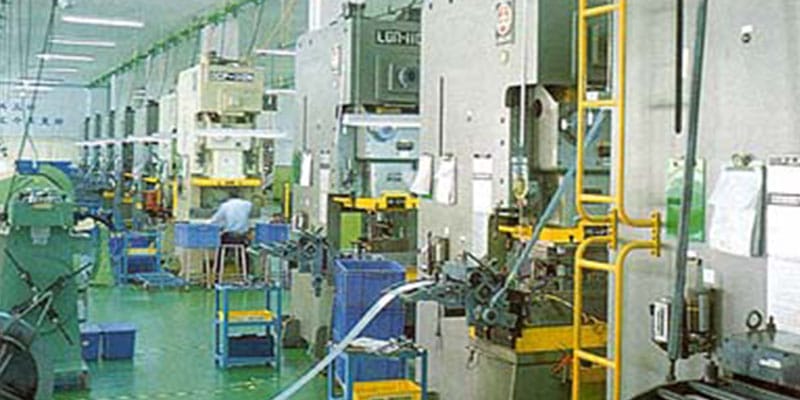
A large stamping-press manufacturer
ARENA Metal is a large stamping-press manufacturer with 200–300 employees in Dongguan. Its machines are built from complex structures: one model can contain more than 600 parts and components, with semi-finished products and sub-parts linked through multiple processing stages.
QUALI's ERP (formerly Jiang's software) was used as the specialised software for the machinery business. The implementation connected engineering, production management, purchasing, warehouse quality control, warehousing, manufacturing, and outsourced processing through BOM, MRP, and barcode operations.
Engineering and order production
Engineering established a hierarchical BOM together with process management. Semi-finished products required raw materials and several processing steps. Some steps were completed in-house and some were outsourced. The linked BOM and process structure provided the basis for viewing the machine’s complete structure and total cost.
Production management worked mainly from customer orders. After an order was entered, SO2MO converted it into one or more production orders according to the parent and child BOM. Semi-finished products requiring processing were then converted in batches through MO2PD into manufacturing orders.
Purchasing from material demand to order
Purchasing used MO2PO to convert component requirements into purchase orders. The first screen added together the same materials into a material demand table. The second compared inventory, planned receipts, production-line inventory, and safety stock to calculate shortages. The third displayed prices from multiple suppliers for the same material. The lowest price was shown by default, while staff could manually select another supplier.
The fourth screen previewed the purchase recommendation. After confirmation, the purchaser entered the purchase order. This MRP process reduced material calculation, delivery-date calculation, and price-comparison work from one week to five minutes, while helping prevent small parts from being missed.
Quality, warehouse, and production records
Supplier shipments first entered the awaiting-inspection warehouse. The warehouse QC team performed IQC inspection and used AQL standards to decide acceptance, rejection, or special acceptance into inventory. The system could produce quality Pareto charts and statistics for supplier defect rates and late-delivery rates.
The warehouse printed material requisition forms with barcodes. Staff scanned the form, reduced the inventory account, picked the material from its storage location, and placed it on a cart for manufacturing. Warehouse staff could also deliver material to the shop floor; large machine bases could be moved directly with a crane.
Each process order in manufacturing carried a barcode. Scanning at the start and finish of each process recorded actual hours and automatically generated the daily production report. For outsourced work, staff scanned the start code when material was issued and the finish code when the work returned. The system then calculated subcontracting cost and accounts payable without calculating working hours.
Operational effects
Before the system, the factory managed its accounts manually in Excel. Production and outsourced-process progress could be monitored without entering the workshop. Barcode reporting replaced handwritten daily production reports, saving time and reducing repeated work.
Barcode records also gave working-hour information a more credible basis for performance assessment and performance bonus arrangements. Barcode-based management made delays visible and supported more self-directed follow-up, reducing the management effort needed for routine tracking. Material issuing and receipt by barcode reduced input time and errors, increased inventory accuracy, and reduced time spent checking mistakes.
The operating steps required only simple scanner training, and the production line accepted them readily. Manufacturing orders could be printed with a laser or inkjet printer. The implementation reached a working level in about two months.